
An IPO is one of the most central events in a company's life cycle on the capital market and often marks a clear transition in how the company is financed and owned. The term often comes up in connection with stock exchange listings, growth companies and changes in ownership structure, but it has a clear and well-defined meaning.
IPO is an abbreviation of Initial Public Offering and means that a company is listed on a regulated marketplace for the first time and offers its shares to the public. In Swedish the term börsintroduktion is often used. In Sweden, listings normally take place on regulated marketplaces such as Nasdaq Stockholm, where both the marketplace's rules and supervision by the Swedish Financial Supervisory Authority (Finansinspektionen) are central parts of the framework.
What does an IPO mean in practice?
In practice, an IPO means that a company goes from being private or unlisted to being public and available for trading on a regulated marketplace. Before the listing, the shares are usually owned by founders, employees, early investors or venture capital firms. The listing opens ownership up to a broader group of investors.
In connection with an IPO, an offering price for the share is set, based on a valuation drawn up together with advisers and issuing institutions. Investors are given the opportunity to subscribe for shares ahead of the first day of trading, after which price formation is governed by supply and demand in the market.
At the same time, the listing means that the company is subject to increased disclosure requirements. As a public company, it is required to report its finances on an ongoing basis and disclose material events, which increases transparency but also places higher demands on organisation and governance.
Why do companies carry out an IPO?
There are several reasons why a company chooses to carry out an IPO. A common motive is raising capital. By selling newly issued shares to the public, the company can bring in new capital that can be used for growth, investments, research, expansion into new markets or to strengthen the balance sheet.
An IPO can also serve as a way for existing owners to partly divest their holdings or to create the conditions for future sales. Through the listing, founders and early investors can get a functioning marketplace where the shares become liquid and where the value of the holding can be realised more clearly over time.
Another reason is visibility and credibility. A listed company often gets more attention from the media, analysts and institutional investors. For some companies this can make business relationships, recruitment and international expansion easier.
How does an IPO work?
An IPO is a structured process that often stretches over several months and requires extensive preparation. The process often begins with internal preparations in which the company reviews its organisation, reporting and corporate governance. External advisers are then engaged, for example investment banks, legal advisers and auditors.
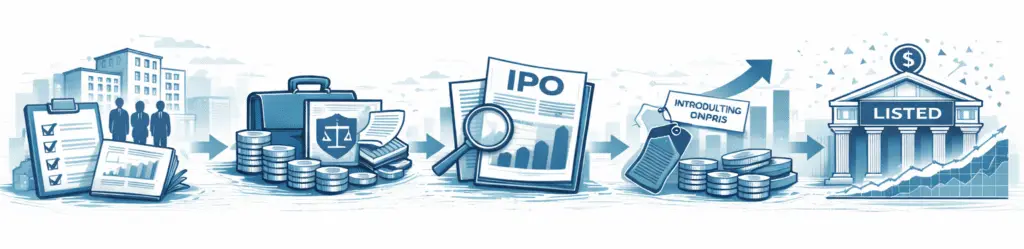
An IPO process usually consists of several clear steps. The scope and exact design of the process can vary between companies, marketplaces and market conditions, but the following steps are common:
- The company prepares its organisation, governance and financial reporting ahead of the listing.
- External advisers are engaged for valuation, legal matters, auditing and structuring.
- A prospectus is produced with information about the business, financial position and risks.
- The offering price is set based on the valuation and investor interest.
- The share is listed and trading begins on the stock exchange.
A central part of the process is drawing up a prospectus, which in Sweden must be approved by Finansinspektionen before the offer can be carried out. The prospectus is an extensive document that describes the company's business, financial position, risk factors and future prospects. Its purpose is to give investors enough information to make a well-founded investment decision.
What happens after an IPO?
After the listing, the share begins to be traded freely in the market, and the company's valuation is continuously affected by the market's view of its results, growth and future prospects.
At the same time, a new set of rules comes into force. In Sweden, listed companies are subject to, among other things, supervision by Finansinspektionen, the EU Market Abuse Regulation and the listing requirements that apply to the marketplace in question. This means requirements for regular reporting, the handling of inside information and clear communication with the market.
For shareholders, the listing usually means increased liquidity compared with the time as an unlisted company, but also that the share price may show larger short-term swings, especially during the initial trading period.
What does an IPO mean for existing shareholders?
For existing shareholders in an unlisted company, an IPO can bring both opportunities and changes. One important effect is that the shares get a public market price. This creates transparency around the valuation and makes it easier to assess the value of the holding.
At the same time, it is common for existing owners to be subject to so-called lock-up periods after the listing. This means that for a certain period they may not sell their shares on the stock exchange. The purpose is to create stability in the share during the initial trading period.
When the lock-up period expires, existing shareholders have the opportunity to sell their shares on the open market, on the same terms as other investors. It is, however, important to remember that the market price may differ from the price set at the offering.
IPOs in relation to unlisted shares
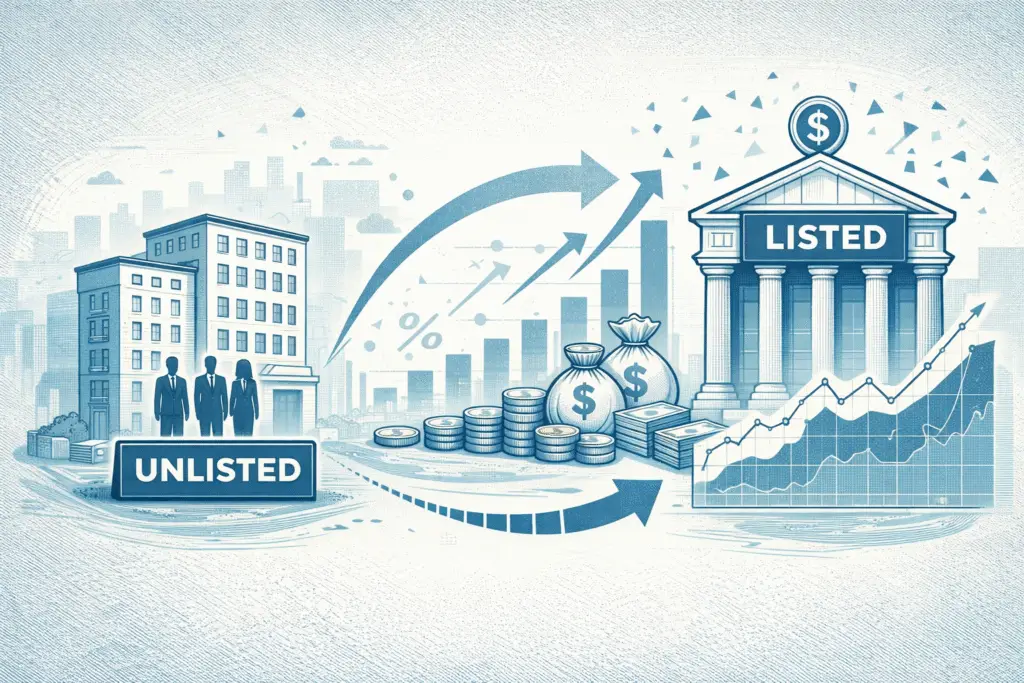
An IPO marks the transition from unlisted to listed trading. For investors who own or trade unlisted shares, this is a central event. In many cases unlisted trading ends when the company is listed, and the share moves to being traded on the stock exchange.
On marketplaces such as Eqvor, where unlisted shares are traded before any stock exchange listing, understanding the IPO process becomes particularly relevant from an investor's perspective. Eqvor also provides an IPO calendar that aims to give an overview of companies that, according to public sources and media coverage, may be heading for the stock exchange. For investors this means that an IPO can change the liquidity, pricing and availability of a company that has previously been traded outside the stock exchange.
For the market, this means that the company becomes available to a broader investor base, while the rules change. The differences between unlisted and listed trading become clear in terms of transparency, liquidity and disclosure requirements.

IPOs in a wider context
An IPO acts as a bridge between unlisted and listed ownership. For the company, the listing means access to the capital market and a more public valuation, while investors get access to a regulated and transparent trading environment.
For investors who are interested in companies before any stock exchange listing, there is the opportunity to trade unlisted shares via Eqvor. On the platform, investors can follow and trade in unlisted companies over time, including companies that may carry out an IPO in the future.
Eqvor also provides an IPO calendar that gives an overview of companies that, based on public sources and media coverage from established business media, have been identified as potential candidates for a future stock exchange listing. In this way, understanding of the IPO process is linked to the unlisted market and its development.